
Films AI's strangest bottleneck isn't GPUs
AI's strangest bottleneck isn't GPUs

In two sentences
AI moves at software speed; the grid it runs on moves at industrial speed. This film follows the electricity to the machine almost nobody notices, the large power transformer, and shows why some now take more than three years to arrive, who gets them first, and how makers are racing to catch up.
Chapters
What we know and what we don'tWhat we know
Established
A hypothetical advanced AI data center can represent billions of dollars of investment and contain tens of thousands of processors, extensive fiber, cooling, and backup generation.
Data-center projects can be delayed, limited, or made unfeasible by grid-connection and electrical-infrastructure constraints.
Federal Energy Regulatory Commission: FERC action on large-load integration (opens the source) ↗ · International Energy Agency: IEA Energy and AI (opens the source) ↗
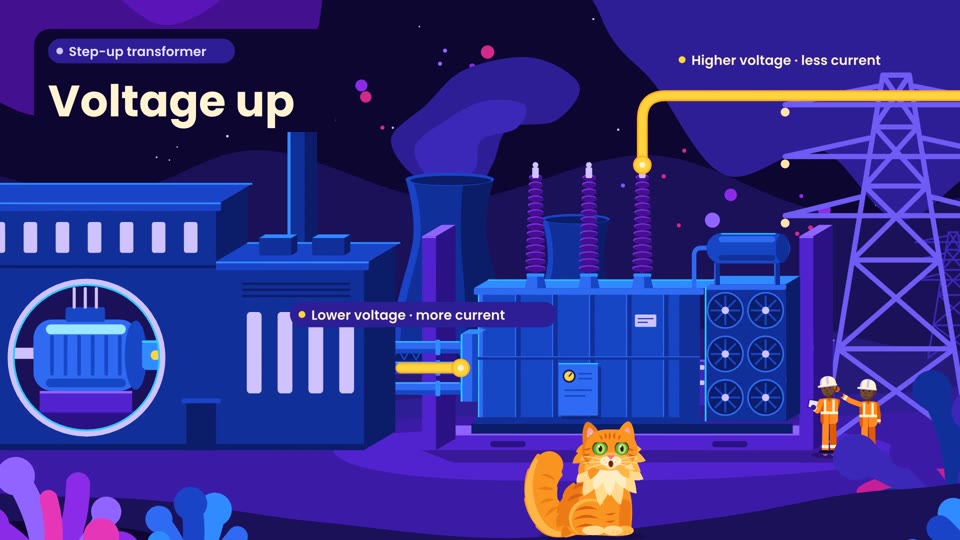
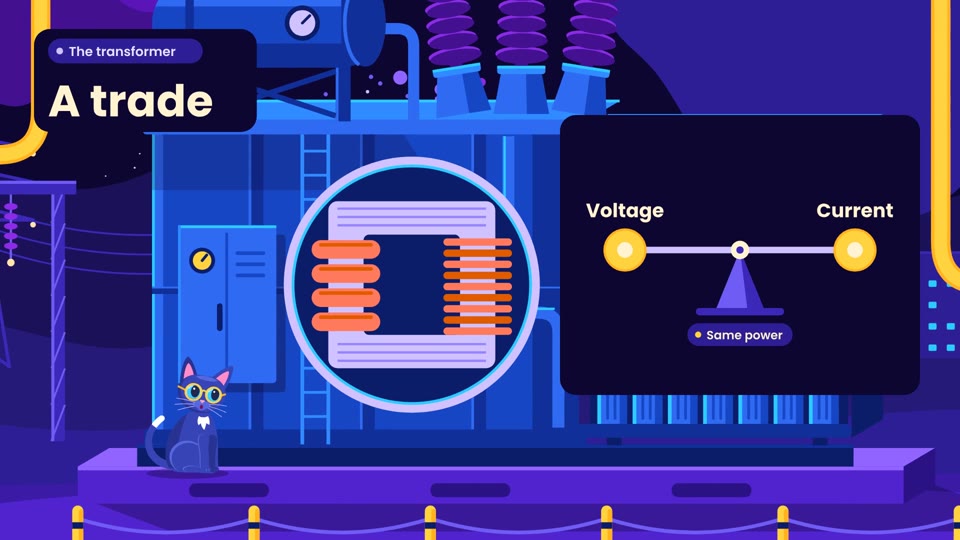
A conventional transformer transfers AC power between windings by electromagnetic induction; its winding ratio changes voltage and current, and higher-voltage/lower-current transmission reduces resistive line loss for a given transferred power.
US Department of Energy Alternative Fuels Data Center: DOE electricity production and distribution explainer (opens the source) ↗ · Electronic Code of Federal Regulations: Current US regulatory distribution-transformer definition (opens the source) ↗ · OpenStax: Transformer physics reference (opens the source) ↗
Uncertain or limited
Forecasts depend on the IEA report's modelling assumptions. “At risk of delay” does not prove that a completed named facility is sitting without power.
International Energy Agency, IEA Energy and AI (opens the source) ↗
This supports the systemic interconnection constraint, not the stronger image of a completed data center waiting powerless for one missing transformer.
Federal Energy Regulatory Commission, FERC action on large-load integration (opens the source) ↗
This is a legal definition for a specific federal efficiency-regulation subpart, not the only engineering usage worldwide. The current eCFR supersedes an older DOE summary page that still displays a 2,500-kVA ceiling.
Some large power and generator step-up transformers needed for electrical-system expansion can take more than three years from order to delivery.
US Department of Energy: DOE Large Power Transformer Resilience Report (opens the source) ↗ · Wood Mackenzie: Wood Mackenzie 2024 transformer-market analysis (opens the source) ↗ · Siemens Energy: Siemens Energy Charlotte transformer factory (opens the source) ↗ · Reuters: Reuters on the 2026 equipment scramble (opens the source) ↗
Transformers step voltage up for efficient long-distance transmission and step it down through substations and local distribution, making them necessary connection points for most conventional grid paths.
US Department of Energy Alternative Fuels Data Center: DOE electricity production and distribution explainer (opens the source) ↗ · US Department of Energy: DOE Large Power Transformer Resilience Report (opens the source) ↗
Data centers can be developed materially faster than the new grid infrastructure required to serve them.
International Energy Agency: IEA Electricity 2026 grid timelines (opens the source) ↗ · International Energy Agency: IEA grid-development timelines (opens the source) ↗ · JLL: JLL 2026 Global Data Center Outlook (opens the source) ↗
Large power transformers are custom-built around voltage, impedance, safety, site, and jurisdiction requirements, while constrained production queues can push procurement beyond 36 months.
US Department of Energy: DOE Large Power Transformer Resilience Report (opens the source) ↗ · Wood Mackenzie: Wood Mackenzie 2024 transformer-market analysis (opens the source) ↗
Large-transformer manufacturing depends on specialized electrical steel, copper conductors/windings, insulation, skilled labor, engineering, testing, transport, and installation.
US Department of Energy: DOE Large Power Transformer Resilience Report (opens the source) ↗ · US Department of Energy: DOE electric-grid supply-chain manufacturing report (opens the source) ↗ · Wood Mackenzie: Wood Mackenzie 2024 transformer-market analysis (opens the source) ↗
A representative modern data-center path can include a grid/interconnection substation, MV-to-LV facility transformers, switchgear and UPS systems, PDU or busway distribution, and rack/server electronic converters; architectures vary, and not every PDU contains a transformer.
US Department of Energy Office of Electricity: DOE 2026 transformer taxonomy and data-center step-down discussion (opens the source) ↗ · DOE Federal Energy Management Program / NREL: DOE/NREL data-center electrical-system guide (opens the source) ↗ · Pacific Northwest National Laboratory for DOE: PNNL data-center power-system models (opens the source) ↗
The transmission grid is generally networked, so a generation-to-data-center sequence is an explanatory representative path rather than a literal dedicated route followed by identifiable electrons from one plant.
US Department of Energy: DOE Large Power Transformer Resilience Report (opens the source) ↗ · US Department of Energy: DOE grid, substation, and transformer overview (opens the source) ↗
A generator step-up transformer is the main transformer directly connected to a generator that raises generator-output voltage to transmission-system voltage.
US Department of Energy: DOE grid, substation, and transformer overview (opens the source) ↗ · Idaho National Laboratory for DOE: Idaho National Laboratory GSU technical definition (opens the source) ↗
A substation power transformer changes voltage between grid levels or between the grid and a large load, but a substation also contains switching, protection, buses, controls, and other equipment; a substation transformer is not automatically an LPT.
US Department of Energy: DOE grid, substation, and transformer overview (opens the source) ↗ · Pacific Northwest National Laboratory for DOE: PNNL data-center power-system models (opens the source) ↗
The IEA's 2026 outlook projects global data-center electricity consumption rising from 485 TWh in 2025 to about 950 TWh in 2030, while electricity consumption from AI-focused data centers triples over the same period.
International Energy Agency: IEA 2026 update on energy and AI (opens the source) ↗
Data-center expansion is projected to account for nearly half of US electricity-demand growth through 2030.
International Energy Agency: IEA Energy and AI (opens the source) ↗ · International Energy Agency: IEA 2026 update on energy and AI (opens the source) ↗
Transformer lead times can dictate overall grid-project schedules; buyers may reserve manufacturing slots before associating equipment with a specific project, and completed assets can sit idle while awaiting transformers.
Reuters: Reuters on US transformer imports, slots, and investment (opens the source) ↗
The IEA says data centers can be developed in roughly one to three years while new grid infrastructure may take five to fifteen years.
International Energy Agency: IEA Electricity 2026 grid timelines (opens the source) ↗ · International Energy Agency: IEA grid-development timelines (opens the source) ↗
JLL reports that 57% of data-center projects were delayed by at least three months in 2025 and that developers preorder some materials as much as 24 months ahead.
JLL: JLL 2026 Global Data Center Outlook (opens the source) ↗
Some utilities reserve or procure transformer capacity years before construction begins, in some contexts as much as five years ahead.
Reuters: Reuters on the 2026 equipment scramble (opens the source) ↗ · Reuters: Reuters on US transformer imports, slots, and investment (opens the source) ↗
Approximately 55% of in-service US distribution transformers are older than 33 years, and many units operate beyond a commonly expected 30–40-year life.
US Department of Energy: DOE distribution-transformer demand drivers (opens the source) ↗ · National Renewable Energy Laboratory: NREL distribution-transformer fleet analysis (opens the source) ↗
A 2022 joint industry letter said average US distribution-transformer procurement lead times across all segments and voltage classes rose 443% between 2020 and 2022, from two to four months to more than one year.
US Department of Energy: DOE congressional testimony on distribution transformers (opens the source) ↗ · American Public Power Association: 2022 joint industry letter reported by APPA (opens the source) ↗
Wood Mackenzie data reported by Reuters showed US generator step-up transformer lead times surpassing 160 weeks by Q1 2026, compared with an average 143 weeks in 2024.
Reuters: Reuters on the 2026 equipment scramble (opens the source) ↗
Utilities and developers are responding to long transformer lead times with advance purchasing, long-term agreements, upfront or favorable payment terms, refurbishment, and supplier diversification; Reuters also reported that smaller utilities may lack the scale to benefit equally from long-term agreements.
Reuters: Reuters on the 2026 equipment scramble (opens the source) ↗
Reuters reported transformer-manufacturing expansions by Hitachi Energy, Siemens Energy, GE Vernova, Hyosung HICO, and WEG, and reported Siemens' North Carolina plan increasing from $150 million to $421 million.
Hitachi Energy: Hitachi Energy South Boston announcement (opens the source) ↗ · Siemens Energy: Siemens Energy Charlotte transformer factory (opens the source) ↗ · Siemens Energy: Siemens Energy 2026 US investment program (opens the source) ↗ · Siemens Energy: Siemens Energy 2026 US construction/status material (opens the source) ↗ · Reuters: Reuters on US transformer imports, slots, and investment (opens the source) ↗
On 2026-06-29, Hitachi Energy broke ground on a $457 million South Boston, Virginia project that the company says will create about 825 long-term jobs and become the largest US facility for large-power-transformer production.
Hitachi Energy: Hitachi Energy South Boston announcement (opens the source) ↗ · Reuters: Reuters on US transformer imports, slots, and investment (opens the source) ↗
On 2026-09-15, Hitachi Energy announced plans for a new $528 million transformer-manufacturing facility in Gallman, Mississippi, with construction expected to begin in late 2026 and production scheduled to start in 2029.
Hitachi Energy: Hitachi Energy Mississippi transformer-factory announcement (opens the source) ↗
On 2026-04-20, a White House Defense Production Act determination listed transformers, electrical core steel, and other grid infrastructure and supply-chain capabilities as resources, materials, or critical technology items essential to national defense.
The White House: White House Defense Production Act determination (opens the source) ↗
Reuters reported that long-term agreements and sales of future production slots can give transformer manufacturers the financial certainty needed to invest in factory expansion.
Reuters: Reuters on US transformer imports, slots, and investment (opens the source) ↗
Roseville Electric said procurement that once took about one year had stretched to three years, that it bought some large substation transformer equipment up to five years ahead, and that roughly three-quarters of recent bids came from foreign suppliers including China and South Korea.
Reuters: Reuters on the 2026 equipment scramble (opens the source) ↗
Ideal-transformer equations neglect real losses. Documentary narration should not imply transformers create power or operate at 100% efficiency.
OpenStax, Transformer physics reference (opens the source) ↗
The voltage ranges are typical examples, not universal boundaries. This source explains the grid path, not detailed transformer taxonomy.
US context; July 2024 market snapshot; the report's 100 MVA definition controls.
US Department of Energy, DOE Large Power Transformer Resilience Report (opens the source) ↗
Industry analysis, not a universal engineering constant. Preserve the covered categories and observation date.
Wood Mackenzie, Wood Mackenzie 2024 transformer-market analysis (opens the source) ↗
The 160-week number is specifically for **generator step-up transformers in the cited US market context**. It is an order-to-delivery lead-time figure, not a claim about every transformer. Forecasts and market-share scenarios require attribution.
Reuters, Reuters on the 2026 equipment scramble (opens the source) ↗
Company statements; the claimed completion/production timetable requires a later operational-status check before narration.
Siemens Energy, Siemens Energy Charlotte transformer factory (opens the source) ↗
High-level comparative ranges.
International Energy Agency, IEA Electricity 2026 grid timelines (opens the source) ↗
Global/high-level comparison; use SRC-012 for the explicit data-center comparison.
International Energy Agency, IEA grid-development timelines (opens the source) ↗
Industry report; retain its project/sample definitions if using the numbers in narration. The 18-month build figure is not a full grid-interconnection timeline.
JLL, JLL 2026 Global Data Center Outlook (opens the source) ↗
LPT manufacturing context. Specific factory methods and automation levels vary.
US Department of Energy, DOE electric-grid supply-chain manufacturing report (opens the source) ↗
The “two phases” statement is a high-level explanatory model, not a universal one-line design. A PDU may function as distribution/switching equipment without containing a transformer.
This is a best-practices guide, not a declaration that every data center uses the same UPS/PDU topology or voltage sequence.
The report's models are generic starting points for grid studies, not a literal design of any one facility. Future DC/SST architectures must not be depicted as the universal present-day layout.
The example voltage ranges and market taxonomy are dated 2006 and should be treated as illustrative. Use current DOE/eCFR sources for current regulatory boundaries.
US Department of Energy, DOE grid, substation, and transformer overview (opens the source) ↗
Its detailed operating discussion centers on large nuclear/thermal-plant GSUs. Smaller renewable collection-system step-up transformers are not automatically the same product category.
Forecasts depend on the IEA's modelling assumptions. The figures are global electricity-consumption projections, not US capacity figures or observed outcomes.
International Energy Agency, IEA 2026 update on energy and AI (opens the source) ↗
Several figures rely on proprietary Wood Mackenzie data or named interviews whose methodology is not public in the article. Attribute them. “Demand” is not sufficiently defined for unit/MVA/revenue interpretation.
Reuters, Reuters on US transformer imports, slots, and investment (opens the source) ↗
Distribution transformers only.
US Department of Energy, DOE distribution-transformer demand drivers (opens the source) ↗
Keep article statements and underlying model/report findings distinct. Distribution transformers only.
Historical distribution-transformer snapshot; “up to two years” is not an average.
This is not a DOE statistic. It is a trade-group statement from a specific 2020–2022 period. The recovered source does **not** support “22–33 months.”.
American Public Power Association, 2022 joint industry letter reported by APPA (opens the source) ↗
“Nation's largest” and job projections are the company's claims about the planned facility, not an independently audited current ranking or completed employment count.
Hitachi Energy, Hitachi Energy South Boston announcement (opens the source) ↗
The release does not independently isolate or confirm the Reuters-reported $421 million revised North Carolina comparison. Use Reuters attribution for that exact number.
Siemens Energy, Siemens Energy 2026 US investment program (opens the source) ↗
Company-controlled status material and a moving press portal. Recheck the specific factory immediately before Act IV narration or publication; absence of an operating announcement is not proof that no production activity exists.
Siemens Energy, Siemens Energy 2026 US construction/status material (opens the source) ↗
Company-controlled announcement. The factory was planned, not operational, as of the research checkpoint. Recheck construction and production status near publication.
Hitachi Energy, Hitachi Energy Mississippi transformer-factory announcement (opens the source) ↗
Preserve the legal document's wording. This was a Defense Production Act determination, not a generic technical designation or proof that each listed supply chain faces the same severity.
The White House, White House Defense Production Act determination (opens the source) ↗
Our conclusion from the sources
Transformer constraints predate the current AI boom and reflect multiple pressures, while rapid data-center growth is an accelerant rather than the sole cause.
Sources, by chapter
“Imagine spending billions of dollars on one of the most advanced computing facilities on Earth.”
As checked: A hypothetical advanced AI data center can represent billions of dollars of investment and contain tens of thousands of processors, extensive fiber, cooling, and backup generation.
“You can't run it — at least, not at the scale it was built for.”
As checked: Data-center projects can be delayed, limited, or made unfeasible by grid-connection and electrical-infrastructure constraints.
“Not a supercomputer. Not some experimental chip. A machine built on a principle we've understood since the nineteenth century.”
As checked: A conventional transformer transfers AC power between windings by electromagnetic induction; its winding ratio changes voltage and current, and higher-voltage/lower-current transmission reduces resistive line loss for a given transferred power.
- GovernmentDOE electricity production and distribution explainerUS Department of Energy Alternative Fuels Data Center · technical explainer (opens the source)
- ResearchCurrent US regulatory distribution-transformer definitionElectronic Code of Federal Regulations · accessed 9 Aug 2026 (opens the source)
- ResearchTransformer physics referenceOpenStax · 2016, open textbook (opens the source)
“Yet some large transformers needed to expand the electrical system can take more than three years to arrive.”
As checked: Some large power and generator step-up transformers needed for electrical-system expansion can take more than three years from order to delivery.
- GovernmentDOE Large Power Transformer Resilience ReportUS Department of Energy · July 2024, report (opens the source)
- ResearchWood Mackenzie 2024 transformer-market analysisWood Mackenzie · 2 Apr 2024 (opens the source)
- CompanySiemens Energy Charlotte transformer factorySiemens Energy · 14 Feb 2024, company announcement (opens the source)
- ReportingReuters on the 2026 equipment scrambleReuters · 9 Jul 2026, ; accessible syndication copy (opens the source)
“Without the right transformers, power can't reach the facility at the voltages it needs.”
As checked: Transformers step voltage up for efficient long-distance transmission and step it down through substations and local distribution, making them necessary connection points for most conventional grid paths.
“That's the strange contradiction at the center of the AI boom. Models can improve in months. Billions of dollars can move in days. Computing hardware can fill a warehouse.”
As checked: Data centers can be developed materially faster than the new grid infrastructure required to serve them.
“But factories have limits. Grids take years to expand. Heavy machines still have to be built, shipped, installed, and tested.”
As checked: Large power transformers are custom-built around voltage, impedance, safety, site, and jurisdiction requirements, while constrained production queues can push procurement beyond 36 months.
“But factories have limits. Grids take years to expand. Heavy machines still have to be built, shipped, installed, and tested.”
As checked: Large-transformer manufacturing depends on specialized electrical steel, copper conductors/windings, insulation, skilled labor, engineering, testing, transport, and installation.
- GovernmentDOE Large Power Transformer Resilience ReportUS Department of Energy · July 2024, report (opens the source)
- ResearchDOE electric-grid supply-chain manufacturing reportUS Department of Energy · February 2022 (opens the source)
- ResearchWood Mackenzie 2024 transformer-market analysisWood Mackenzie · 2 Apr 2024 (opens the source)
“Picture one representative journey from a large power station to a server rack.”
As checked: A representative modern data-center path can include a grid/interconnection substation, MV-to-LV facility transformers, switchgear and UPS systems, PDU or busway distribution, and rack/server electronic converters; architectures vary, and not every PDU contains a transformer.
- GovernmentDOE 2026 transformer taxonomy and data-center step-down discussionUS Department of Energy Office of Electricity · event dated 5 Mar 2026, transcript with national-laboratory and industry participants (opens the source)
- ResearchDOE/NREL data-center electrical-system guideDOE Federal Energy Management Program / NREL · revised July 2024 (opens the source)
- ResearchPNNL data-center power-system modelsPacific Northwest National Laboratory for DOE · December 2025 (opens the source)
“Picture one representative journey from a large power station to a server rack.”
As checked: The transmission grid is generally networked, so a generation-to-data-center sequence is an explanatory representative path rather than a literal dedicated route followed by identifiable electrons from one plant.
“Near the generator, a step-up transformer raises the voltage. The same power can now travel with less current — so less energy is lost as heat over long distances.”
As checked: A generator step-up transformer is the main transformer directly connected to a generator that raises generator-output voltage to transmission-system voltage.
“Substations switch, protect, and route power. Other transformers may lower its voltage several times.”
As checked: A substation power transformer changes voltage between grid levels or between the grid and a large load, but a substation also contains switching, protection, buses, controls, and other equipment; a substation transformer is not automatically an LPT.
Also used in this chapter
- GovernmentDOE electricity production and distribution explainerUS Department of Energy Alternative Fuels Data Center · technical explainer (opens the source)
- ResearchCurrent US regulatory distribution-transformer definitionElectronic Code of Federal Regulations · accessed 9 Aug 2026 (opens the source)
- ResearchTransformer physics referenceOpenStax · 2016, open textbook (opens the source)
“The International Energy Agency's updated 2026 outlook projects global data-center electricity use rising from 485 terawatt-hours in 2025 to about 950 by 2030, while electricity use by AI-focused facilities triples.”
As checked: The IEA's 2026 outlook projects global data-center electricity consumption rising from 485 TWh in 2025 to about 950 TWh in 2030, while electricity consumption from AI-focused data centers triples over the same period.
“The agency also projects that data centers will account for nearly half of US electricity-demand growth through the end of the decade.”
As checked: Data-center expansion is projected to account for nearly half of US electricity-demand growth through 2030.
“It can't copy spare grid capacity. Lines, substations, protection systems, and transformers have to be engineered for that place, connected to the wider network, and built around equipment that may already be spoken for.”
As checked: Transformer lead times can dictate overall grid-project schedules; buyers may reserve manufacturing slots before associating equipment with a specific project, and completed assets can sit idle while awaiting transformers.
Also used in this chapter
- GovernmentFERC action on large-load integrationFederal Energy Regulatory Commission · 18 Jun 2026, regulator action (opens the source)
- GovernmentDOE Large Power Transformer Resilience ReportUS Department of Energy · July 2024, report (opens the source)
- ResearchWood Mackenzie 2024 transformer-market analysisWood Mackenzie · 2 Apr 2024 (opens the source)
- ResearchIEA Electricity 2026 grid timelinesInternational Energy Agency · 2026 (opens the source)
- ResearchIEA grid-development timelinesInternational Energy Agency · 2023 (opens the source)
- ResearchJLL 2026 Global Data Center OutlookJLL · 2026 (opens the source)
“The IEA says a data center can be developed in roughly one to three years. New grid infrastructure can take five to fifteen, as routes are studied, permitted, engineered, financed, and equipped.”
As checked: The IEA says data centers can be developed in roughly one to three years while new grid infrastructure may take five to fifteen years.
“Even the faster calendar slips. JLL reported that 57 percent of data-center projects in 2025 were delayed by at least three months.”
As checked: JLL reports that 57% of data-center projects were delayed by at least three months in 2025 and that developers preorder some materials as much as 24 months ahead.
“Then the order of things gets strange. Buyers may reserve a manufacturing slot before deciding which project will get the equipment — buying a place in line for a machine whose destination may not be decided yet.”
As checked: Some utilities reserve or procure transformer capacity years before construction begins, in some contexts as much as five years ahead.
Our conclusion from the sources
“And that capability was already under pressure before AI arrived.”
As checked: Transformer constraints predate the current AI boom and reflect multiple pressures, while rapid data-center growth is an accelerant rather than the sole cause.
- GovernmentDOE Large Power Transformer Resilience ReportUS Department of Energy · July 2024, report (opens the source)
- GovernmentDOE distribution-transformer demand driversUS Department of Energy · 27 Nov 2024, summary (opens the source)
- GovernmentDOE congressional testimony on distribution transformersUS Department of Energy · 13 Sep 2023, testimony (opens the source)
- ResearchNREL distribution-transformer fleet analysisNational Renewable Energy Laboratory · 2024 (opens the source)
- ResearchWood Mackenzie 2024 transformer-market analysisWood Mackenzie · 2 Apr 2024 (opens the source)
- ResearchIEA Energy and AIInternational Energy Agency · 2025 (opens the source)
- ReportingReuters on the 2026 equipment scrambleReuters · 9 Jul 2026, ; accessible syndication copy (opens the source)
Also used in this chapter
“In the United States, availability had been a concern since 2020. Utilities were already replacing aging equipment.”
As checked: Approximately 55% of in-service US distribution transformers are older than 33 years, and many units operate beyond a commonly expected 30–40-year life.
“By late 2022, a joint industry letter reported that average US distribution-transformer procurement times across its surveyed segments had risen 443 percent since 2020. Orders that once took two to four months were taking more than a year.”
As checked: A 2022 joint industry letter said average US distribution-transformer procurement lead times across all segments and voltage classes rose 443% between 2020 and 2022, from two to four months to more than one year.
Also used in this chapter
- GovernmentDOE Large Power Transformer Resilience ReportUS Department of Energy · July 2024, report (opens the source)
- ResearchIEA Energy and AIInternational Energy Agency · 2025 (opens the source)
- ResearchWood Mackenzie 2024 transformer-market analysisWood Mackenzie · 2 Apr 2024 (opens the source)
- ResearchDOE electric-grid supply-chain manufacturing reportUS Department of Energy · February 2022 (opens the source)
- ReportingReuters on the 2026 equipment scrambleReuters · 9 Jul 2026, ; accessible syndication copy (opens the source)
“And the GSU market is already strained. Wood Mackenzie data reported by Reuters showed US order-to-delivery lead times for generator step-up transformers passing 160 weeks in the first quarter of 2026, up from an average of 143 weeks in 2024.”
As checked: Wood Mackenzie data reported by Reuters showed US generator step-up transformer lead times surpassing 160 weeks by Q1 2026, compared with an average 143 weeks in 2024.
“Some data-center developers are buying transformers for on-site generation, to avoid long waits for a grid connection. But generators need electrical hardware too.”
As checked: Utilities and developers are responding to long transformer lead times with advance purchasing, long-term agreements, upfront or favorable payment terms, refurbishment, and supplier diversification; Reuters also reported that smaller utilities may lack the scale to benefit equally from long-term agreements.
Also used in this chapter
- GovernmentDOE electricity production and distribution explainerUS Department of Energy Alternative Fuels Data Center · technical explainer (opens the source)
- GovernmentDOE Large Power Transformer Resilience ReportUS Department of Energy · July 2024, report (opens the source)
- GovernmentDOE grid, substation, and transformer overviewUS Department of Energy · August 2006, report to Congress (opens the source)
- ResearchIdaho National Laboratory GSU technical definitionIdaho National Laboratory for DOE · September 2012 (opens the source)
- ReportingReuters on US transformer imports, slots, and investmentReuters · 11 May 2026, ; accessible syndication copy (opens the source)
“Manufacturers can see the shortage, and the response is real.”
As checked: Reuters reported transformer-manufacturing expansions by Hitachi Energy, Siemens Energy, GE Vernova, Hyosung HICO, and WEG, and reported Siemens' North Carolina plan increasing from $150 million to $421 million.
- CompanyHitachi Energy South Boston announcementHitachi Energy · 29 Jun 2026, company announcement (opens the source)
- CompanySiemens Energy Charlotte transformer factorySiemens Energy · 14 Feb 2024, company announcement (opens the source)
- CompanySiemens Energy 2026 US investment programSiemens Energy · 3 Feb 2026, company announcement (opens the source)
- CompanySiemens Energy 2026 US construction/status materialSiemens Energy · accessed 12 Oct 2026, company status material (opens the source)
- ReportingReuters on US transformer imports, slots, and investmentReuters · 11 May 2026, ; accessible syndication copy (opens the source)
“In June 2026, Hitachi Energy broke ground on a $457 million large-power-transformer facility in South Boston, Virginia, projected to create about 825 jobs.”
As checked: On 2026-06-29, Hitachi Energy broke ground on a $457 million South Boston, Virginia project that the company says will create about 825 long-term jobs and become the largest US facility for large-power-transformer production.
“In September 2026, it announced a $528 million transformer factory in Mississippi, with production scheduled for 2029.”
As checked: On 2026-09-15, Hitachi Energy announced plans for a new $528 million transformer-manufacturing facility in Gallman, Mississippi, with construction expected to begin in late 2026 and production scheduled to start in 2029.
“And in April, a presidential Defense Production Act determination listed transformers, electrical core steel, substations, and other grid equipment among resources essential to national defense.”
As checked: On 2026-04-20, a White House Defense Production Act determination listed transformers, electrical core steel, and other grid infrastructure and supply-chain capabilities as resources, materials, or critical technology items essential to national defense.
“Manufacturers also need confidence that the demand will still be there after the new bays open. Long-term agreements, and selling future production slots, can give them enough certainty to expand.”
As checked: Reuters reported that long-term agreements and sales of future production slots can give transformer manufacturers the financial certainty needed to invest in factory expansion.
Also used in this chapter
- GovernmentDOE Large Power Transformer Resilience ReportUS Department of Energy · July 2024, report (opens the source)
- ResearchWood Mackenzie 2024 transformer-market analysisWood Mackenzie · 2 Apr 2024 (opens the source)
- ResearchDOE electric-grid supply-chain manufacturing reportUS Department of Energy · February 2022 (opens the source)
“Roseville Electric, a California utility, said it once bought project equipment about a year ahead. By 2026, it was working on a three-year timeline, and buying some large substation transformer equipment five years before it expected to need it.”
As checked: Roseville Electric said procurement that once took about one year had stretched to three years, that it bought some large substation transformer equipment up to five years ahead, and that roughly three-quarters of recent bids came from foreign suppliers including China and South Korea.
Also used in this chapter
This chapter states no new facts of its own.
Also used in this chapter
- GovernmentFERC action on large-load integrationFederal Energy Regulatory Commission · 18 Jun 2026, regulator action (opens the source)
- GovernmentDOE Large Power Transformer Resilience ReportUS Department of Energy · July 2024, report (opens the source)
- ResearchIEA Energy and AIInternational Energy Agency · 2025 (opens the source)
- ResearchWood Mackenzie 2024 transformer-market analysisWood Mackenzie · 2 Apr 2024 (opens the source)
- ResearchIEA Electricity 2026 grid timelinesInternational Energy Agency · 2026 (opens the source)
- ResearchIEA grid-development timelinesInternational Energy Agency · 2023 (opens the source)
- ResearchJLL 2026 Global Data Center OutlookJLL · 2026 (opens the source)
- ResearchDOE electric-grid supply-chain manufacturing reportUS Department of Energy · February 2022 (opens the source)
- ReportingReuters on the 2026 equipment scrambleReuters · 9 Jul 2026, ; accessible syndication copy (opens the source)
What you are seeing
Every scene of the film is one of four kinds, and the picture always says which. This film uses two of them.
Explanation
The idea itself, drawn with our own pictures.
Scenario
A possible future: always labelled, never shown as fact.


Explanation · 90
- The permanent grid connection isn't ready. And one of the…
- Not a supercomputer. Not some experimental chip. A machine built…
- Yet some large transformers needed to expand the electrical system…
- That's the strange contradiction at the center of the AI…
- But factories have limits. Grids take years to expand. Heavy…
- AI's strangest bottleneck may not be an algorithm. It may…
- To see why, follow the electricity to the machine almost…
- A transformer doesn't generate electricity. Think of it as a…
- Picture one representative journey from a large power station to…
- Near the generator, a step-up transformer raises the voltage. The…
- Then the journey works its way back down. Electricity enters…
- Substations switch, protect, and route power. Other transformers may lower…
- At the edge of the campus, another substation can step…
- Busways carry it toward the racks. Finally, electronic converters produce…
- Real grids and data centers are laid out in different…
- The transformer creates none of that energy. It makes the…
- Which leaves a stranger question. If this machine is so…
- Because the machine didn't suddenly change. What changed was the…
- AI campuses pack enormous demand into single locations, often faster…
- The International Energy Agency's updated 2026 outlook projects global data-center…
- The agency also projects that data centers will account for…
- But the grid never experiences that growth as one smooth…
- It experiences one enormous request, landing on one transmission corridor,…
- A developer can order servers, pour concrete, repeat a building…
- It can't copy spare grid capacity. Lines, substations, protection systems,…
- That's what AI changed. Not the laws of electricity —…
- The building and the grid are racing on different calendars.
- The IEA says a data center can be developed in…
- Even the faster calendar slips. JLL reported that 57 percent…
- Developers were preordering some materials as much as two years…
- Then the order of things gets strange. Buyers may reserve…
- Reuters has reported finished grid assets sitting idle, waiting for…
- A reservation isn't a transformer. It's a claim on future…
- Money can fund engineering, place orders, and secure a slot.…
- So the bottleneck isn't only electricity. It's the schedule.
- Which raises the obvious question: why not just make more…
- Because a large transformer isn't a standard box waiting for…
- For large power transformers, voltage, impedance, safety equipment, and location…
- Grain-oriented electrical steel is cut and stacked into the core.
- Copper conductors are wound into coils.
- Insulation separates parts carrying enormous electrical stress. Tanks are welded.…
- Each stage depends on specialized machinery, and on people who…
- And every large unit takes up a production slot.
- This isn't a server rack racing down an assembly line.…
- After the factory, physics takes over again: heavy transport, installation,…
- Nothing here is mysterious. Almost everything here is slow.
- Money can secure a place in that sequence. It can't…
- The real constraint is the accumulated capability to turn steel,…
- And that capability was already under pressure before AI arrived.
- This is where the simple story breaks. AI didn't create…
- In the United States, availability had been a concern since…
- The US Department of Energy and the National Renewable Energy…
- Those are distribution transformers — not the large power machines…
- Housing, renewable generation, electrification, and grid modernization all needed equipment.…
- By late 2022, a joint industry letter reported that average…
- The large-transformer market had its own problems: custom designs, full…
- AI entered a supply chain already replacing old equipment, connecting…
- AI didn't start the traffic jam. It arrived with a…
- The obvious fix is to build more power. The grid's…
- At a large conventional power plant, a generator step-up transformer…
- Wind, solar, storage, and smaller generators can use different step-up…
- And the GSU market is already strained. Wood Mackenzie data…
- That doesn't mean every transformer takes 160 weeks. It describes…
- Some data-center developers are buying transformers for on-site generation, to…
- Escape one queue, and you may find you've joined another.
- More generation needs more equipment. More equipment needs more factory…
- Manufacturers can see the shortage, and the response is real.
- In June 2026, Hitachi Energy broke ground on a $457…
- In September 2026, it announced a $528 million transformer factory…
- Siemens Energy announced a $1 billion US manufacturing program that…
- And in April, a presidential Defense Production Act determination listed…
- But a press release isn't a transformer.
- Before a new factory adds capacity, it needs land, buildings,…
- To build transformers faster, the industry first has to build…
- Manufacturers also need confidence that the demand will still be…
- The response is real. So is the clock.
- While capacity is being built, the factory calendar becomes a…
- Roseville Electric, a California utility, said it once bought project…
- Buyers with scale can sign long-term agreements, pay early, and…
- Roseville said roughly three-quarters of its recent bids came from…
- Reuters reported that these strategies can help — but smaller…
- Scarcity rewards buyers with cash, forecasts, supplier relationships, and the…
- The transformer is no longer just equipment. A place in…
- The transformer isn't the only constraint on AI. It's the…
- Software can change in months. Capital can be committed in…
- But electricity still depends on materials, factories, skilled crews, permits,…
- The AI race won't stop. Transformer shortages won't freeze it…
- The ability to coordinate power, land, equipment, suppliers, and years…
- AI may feel weightless. Its limits are not.
- The transformer was never the whole bottleneck. It is the…
Scenario · 10
- Imagine spending billions of dollars on one of the most…
- Inside are tens of thousands of processors, kilometers of fiber,…
- Everything looks ready. There is just one problem.
- You can't run it — at least, not at the…
- Without the right transformers, power can't reach the facility at…
- The computing buildings can arrive faster than their power.
- Now go back to the facility from the beginning.
- Its processors may be ready. Its cooling systems may be…
- Where power and equipment are ready, projects can move. Where…
- The digital future still arrives on the timetable of the…
Transcript
0 · The facility that cannot turn on
- Imagine spending billions of dollars on one of the most advanced computing facilities on Earth.
- Inside are tens of thousands of processors, kilometers of fiber, enormous cooling systems, and backup generators waiting for the grid to fail.
- Everything looks ready. There is just one problem.
- You can't run it — at least, not at the scale it was built for.
- The permanent grid connection isn't ready. And one of the machines that can keep it that way is this: A transformer.
- Not a supercomputer. Not some experimental chip. A machine built on a principle we've understood since the nineteenth century.
- Yet some large transformers needed to expand the electrical system can take more than three years to arrive.
- Without the right transformers, power can't reach the facility at the voltages it needs.
- That's the strange contradiction at the center of the AI boom. Models can improve in months. Billions of dollars can move in days. Computing hardware can fill a warehouse.
- But factories have limits. Grids take years to expand. Heavy machines still have to be built, shipped, installed, and tested.
- AI's strangest bottleneck may not be an algorithm. It may not even be a GPU. It may be steel, copper, factories, electricity — and time.
- To see why, follow the electricity to the machine almost nobody notices. The transformer.
1 · The machine nobody notices
- A transformer doesn't generate electricity. Think of it as a gearbox for alternating current: it trades voltage against current without creating any extra energy.
- Picture one representative journey from a large power station to a server rack.
- Near the generator, a step-up transformer raises the voltage. The same power can now travel with less current — so less energy is lost as heat over long distances.
- Then the journey works its way back down. Electricity enters a network — not a private cable running straight to one data center.
- Substations switch, protect, and route power. Other transformers may lower its voltage several times.
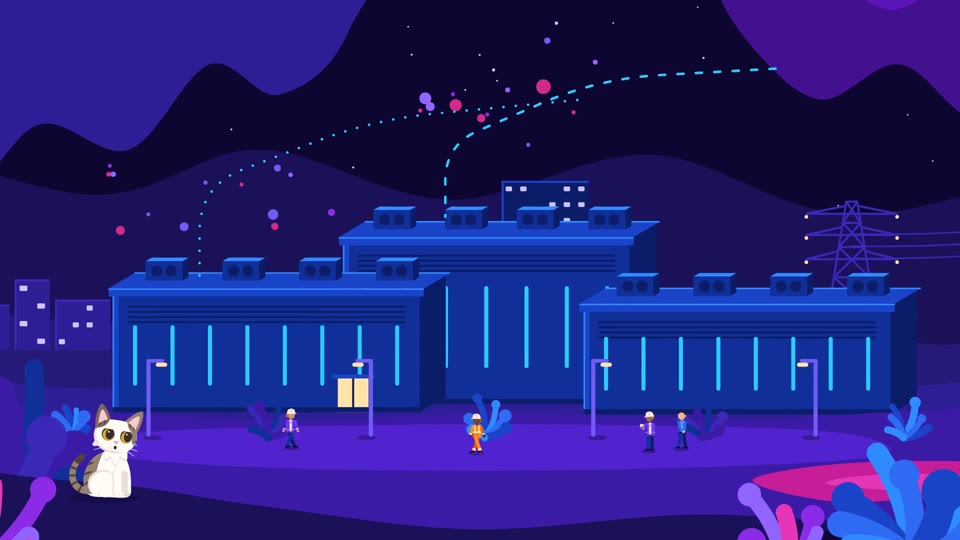
- At the edge of the campus, another substation can step it down again. Inside, facility transformers feed compute blocks. Switchgear and UPS systems protect the flow.
- Busways carry it toward the racks. Finally, electronic converters produce the low-voltage direct current the chips actually use.
- Real grids and data centers are laid out in different ways. But the pattern repeats: voltage goes up to move power efficiently, then comes down to make it useful.
- The transformer creates none of that energy. It makes the journey practical.
- Which leaves a stranger question. If this machine is so old, so common, and so essential — why is it now so hard to get?
2 · Then AI arrived
- Because the machine didn't suddenly change. What changed was the load arriving on the other side.
- AI campuses pack enormous demand into single locations, often faster than the surrounding grid was designed to absorb it.
- The International Energy Agency's updated 2026 outlook projects global data-center electricity use rising from 485 terawatt-hours in 2025 to about 950 by 2030, while electricity use by AI-focused facilities triples.
- The agency also projects that data centers will account for nearly half of US electricity-demand growth through the end of the decade.
- But the grid never experiences that growth as one smooth global curve.
- It experiences one enormous request, landing on one transmission corridor, one substation, one set of transformers — on one deadline.
- A developer can order servers, pour concrete, repeat a building design, and construct compute halls in parallel.
- It can't copy spare grid capacity. Lines, substations, protection systems, and transformers have to be engineered for that place, connected to the wider network, and built around equipment that may already be spoken for.
- That's what AI changed. Not the laws of electricity — the scale and concentration of the request.
- The computing buildings can arrive faster than their power.
3 · The absurd mismatch
- The building and the grid are racing on different calendars.
- The IEA says a data center can be developed in roughly one to three years. New grid infrastructure can take five to fifteen, as routes are studied, permitted, engineered, financed, and equipped.
- Even the faster calendar slips. JLL reported that 57 percent of data-center projects in 2025 were delayed by at least three months.
- Developers were preordering some materials as much as two years ahead.
- Then the order of things gets strange. Buyers may reserve a manufacturing slot before deciding which project will get the equipment — buying a place in line for a machine whose destination may not be decided yet.
- Reuters has reported finished grid assets sitting idle, waiting for transformers. A transmission line can be complete — and the missing machine still decides when it becomes useful.
- A reservation isn't a transformer. It's a claim on future factory time.
- Money can fund engineering, place orders, and secure a slot. It can't instantly create more slots, or squeeze grid construction into a software sprint.
- So the bottleneck isn't only electricity. It's the schedule.
- Which raises the obvious question: why not just make more transformers?
4 · Why can't we just make more?
- Because a large transformer isn't a standard box waiting for a shipping label. It's a carefully tailored industrial machine.
- For large power transformers, voltage, impedance, safety equipment, and location can change the design. Engineers translate a project's electrical requirements into a machine built for its site and system.
- Grain-oriented electrical steel is cut and stacked into the core.
- Copper conductors are wound into coils.
- Insulation separates parts carrying enormous electrical stress. Tanks are welded. The assemblies are inspected and tested.
- Each stage depends on specialized machinery, and on people who know the process by heart: engineers, welders, coil winders, and test technicians.
- And every large unit takes up a production slot.
- This isn't a server rack racing down an assembly line. The transformer has to match the system it will join, then pass its required tests before delivery.
- After the factory, physics takes over again: heavy transport, installation, and more testing on site.
- Nothing here is mysterious. Almost everything here is slow.
- Money can secure a place in that sequence. It can't make the sequence disappear.
- The real constraint is the accumulated capability to turn steel, copper, insulation, engineering, factory space, and skilled work into a reliable machine.
- And that capability was already under pressure before AI arrived.
5 · The twist: AI didn't start this
- This is where the simple story breaks. AI didn't create the transformer shortage.
- In the United States, availability had been a concern since 2020. Utilities were already replacing aging equipment.
- The US Department of Energy and the National Renewable Energy Laboratory estimate that 55 percent of in-service US distribution transformers are at least 33 years old.
- Those are distribution transformers — not the large power machines we just followed. Different machines. Connected pressure.
- Housing, renewable generation, electrification, and grid modernization all needed equipment. Pandemic disruption added material and labor shortages.
- By late 2022, a joint industry letter reported that average US distribution-transformer procurement times across its surveyed segments had risen 443 percent since 2020. Orders that once took two to four months were taking more than a year.
- The large-transformer market had its own problems: custom designs, full production slots, and tight materials and labor.
- AI entered a supply chain already replacing old equipment, connecting new generation, and recovering from disruption. Then it added enormous, concentrated requests on aggressive schedules.
- AI didn't start the traffic jam. It arrived with a convoy — and stepped on the accelerator.
6 · The feedback loop
- The obvious fix is to build more power. The grid's answer: with what equipment?
- At a large conventional power plant, a generator step-up transformer — a GSU — raises the generator's voltage before power enters the transmission system.
- Wind, solar, storage, and smaller generators can use different step-up arrangements. But adding generation still requires connection equipment, engineering, and factory capacity.
- And the GSU market is already strained. Wood Mackenzie data reported by Reuters showed US order-to-delivery lead times for generator step-up transformers passing 160 weeks in the first quarter of 2026, up from an average of 143 weeks in 2024.
- That doesn't mean every transformer takes 160 weeks. It describes this category, in this market, at that moment.
- Some data-center developers are buying transformers for on-site generation, to avoid long waits for a grid connection. But generators need electrical hardware too.
- Escape one queue, and you may find you've joined another.
- More generation needs more equipment. More equipment needs more factory time. The shortcut feeds the bottleneck.
7 · The race to build the boring machine
- Manufacturers can see the shortage, and the response is real.
- In June 2026, Hitachi Energy broke ground on a $457 million large-power-transformer facility in South Boston, Virginia, projected to create about 825 jobs.
- In September 2026, it announced a $528 million transformer factory in Mississippi, with production scheduled for 2029.
- Siemens Energy announced a $1 billion US manufacturing program that includes expanding large-transformer capacity in Charlotte.
- And in April, a presidential Defense Production Act determination listed transformers, electrical core steel, substations, and other grid equipment among resources essential to national defense.
- But a press release isn't a transformer.
- Before a new factory adds capacity, it needs land, buildings, machinery, suppliers, engineers, technicians, training, and test space.
- To build transformers faster, the industry first has to build transformer factories — slowly.
- Manufacturers also need confidence that the demand will still be there after the new bays open. Long-term agreements, and selling future production slots, can give them enough certainty to expand.
- The response is real. So is the clock.
8 · Who gets to the front of the queue?
- While capacity is being built, the factory calendar becomes a resource of its own.
- Roseville Electric, a California utility, said it once bought project equipment about a year ahead. By 2026, it was working on a three-year timeline, and buying some large substation transformer equipment five years before it expected to need it.
- Buyers with scale can sign long-term agreements, pay early, and spread orders across suppliers and countries.
- Roseville said roughly three-quarters of its recent bids came from foreign sources, including China and South Korea.
- Reuters reported that these strategies can help — but smaller utilities may lack the scale they need.
- Scarcity rewards buyers with cash, forecasts, supplier relationships, and the ability to commit years ahead.
- The transformer is no longer just equipment. A place in the factory queue becomes part of the competitive advantage.
9 · The speed limit
- Now go back to the facility from the beginning.
- Its processors may be ready. Its cooling systems may be running tests. The money may already be spent. But until the permanent electrical path is complete, much of that computing power remains potential.
- The transformer isn't the only constraint on AI. It's the machine that makes the deeper constraint visible.
- Software can change in months. Capital can be committed in days. Computing hardware can fill a warehouse.
- But electricity still depends on materials, factories, skilled crews, permits, substations, transmission lines, installation, testing — and time.
- The AI race won't stop. Transformer shortages won't freeze it in place. But the buildout can't advance everywhere at the same speed.
- Where power and equipment are ready, projects can move. Where they aren't, code has to wait for construction.
- The ability to coordinate power, land, equipment, suppliers, and years of planning becomes an advantage alongside chips and models.
- AI may feel weightless. Its limits are not.
- The transformer was never the whole bottleneck. It is the machine that revealed the speed limit.
- The digital future still arrives on the timetable of the physical world.
How this film was made
The animated film

Researched, written, drawn and checked by our team. We use AI tools throughout: research, writing, code-drawn animation, narration and music. Every claim is linked to its source.
Corrections
No corrections to date.
Spotted an error? Write to [email protected] with the film's title.Spotted an error? Email us ↗